
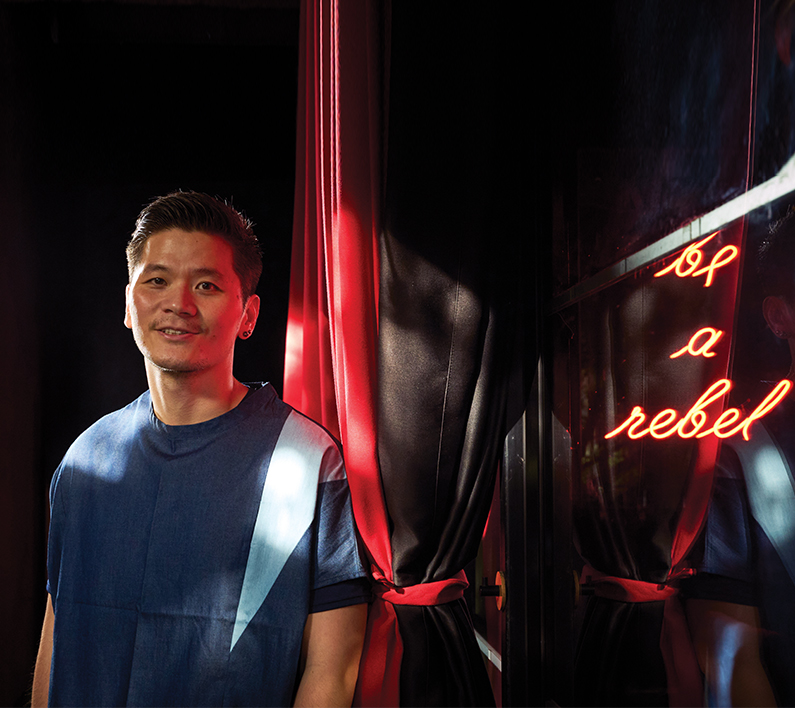
Rydo isn’t simply leading the kitchen raga. He is part of the reason it exists. His identity is written into its name
INTERVIEW BY RASHMI UDAY SINGH
rāga isn’t the story of one chef coming home. RA is Rydo Anton. GA is Gaggan Anand. Together, rāga. Rydo’s journey began far from Delhi. Born in Jakarta, he trained across kitchens in the US and the Middle East and studied culinary arts in Switzerland before an image of Gaggan’s cooking took him to Bangkok. In 2013, he walked into Gaggan and cooked seven dishes for his trial. He got the job. And what began as a job became more than a decade of cooking, travelling, experimenting and building ideas together. From chef de partie to Group Executive Chef, Rydo has spent more than a decade developing a culinary language of his own – precise but never predictable, driven by technique, instinct and a restless need to push an idea further. Today, he leads the culinary direction across the group’s restaurants.
But rāga is different. Here, Rydo isn’t simply leading the kitchen. He is part of the reason it exists. His identity is written into its name. Years of cooking, travelling, experimenting, arguing, failing, fixing and starting again have brought Gaggan and Rydo here. Somewhere along the way, chef and protégé stopped being the story. They became collaborators. Then partners.
What made you join Gaggan in building rāga?
Never in my wildest dreams did I imagine that Gaggan and I would one day open a restaurant together in Delhi. In many ways, it is a homecoming for Gaggan, but for me, the timing, the location and the opportunity simply felt right.
This was a once-in-a-lifetime opportunity. I was given the freedom and trust to build and design the kitchen at rāga from the ground up, to create my own team, train them, and build a kitchen culture that represents what we believe in.
After working together for so many years, rāga also feels like a new chapter in my relationship with Gaggan.
How long did it take to finalise the project?
It took around six months to finalise the project before the construction began. We spent a lot of that time developing the interior design, the business concept and defining what we wanted rāga to become.
I was not interested in simply opening another fine-dining restaurant in Delhi. We wanted to think about the culture of the restaurant – how the kitchen operates, how the team grows, how the guests experience it and how rāga can evolve over time.
What do you think of Gaggan? Of Gaggan’s food?
I have worked with Gaggan for many years, so it’s difficult for me to separate what I think of him as a person from what I think of his food. He’s also like big brother to me. I have seen how his mind works, how restless he can be, and how quickly he can challenge an idea that everyone else thinks it’s finished.
What I admire is that his food has never really been about following rules. There is always a memory, humour and provocation. He can take something rooted in Indian culture and completely change the way you experience it without losing its soul.
We don’t always agree on ideas and I think that’s also healthy. It’s that constant exchange of ideas is probably one of the reasons we have been able to work together for so long.
What are your expectations of rāga?
My expectation is actually simple, I want it to have its own identity. To run its own course.
Of course, we want to cook at the highest level and we want the restaurant to be recognised, but I don’t want rāga to exist simply to chase awards. I want us to create a restaurant that people remember that the food is exciting, the experience is one of a kind, and the team genuinely believes in what they are doing.
I also want rāga to become a place where young chefs can grow. I want to build a strong kitchen culture where young chefs and service team can learn, encouraged to think, question, get a grip and create within our structure.
If years from now people say that rāga has contributed something new to the F&B culture of Delhi and that it has come into a must-visit restaurant, I would consider that a success.
How would you define rāga’s cuisine?
I would describe the cuisine as Indian food built through our own rhythm, emotion and progressive expression. We look at India as the library of flavours, ingredients, memories and techniques, and then interpret those things through our own experiences.
My own journey has taken me through different countries, kitchens and cultures, so naturally those influences become part of the way I cook for others. A familiar flavour might appear in a completely unfamiliar form, while something that looks very contemporary may actually be rooted in a very traditional idea or dish.
rāga in Indian classical music, provides the structure or framework, but within that framework there is freedom for interpretation and expression. That’s how we approach the cuisine.
There is a foundation, there is India, there is technique but there is also freedom to express ourselves.