
What the Purohit family of Shree Thaker Bhojanalay fame can teach the hospitality industry about the art of making guests feel at home
BY SUVIR SARAN
Every year, India’s hospitality industry spends fortunes learning how to welcome people. And yet, tucked above the frenetic lanes of Kalbadevi, in a dining room where the furniture has never tried to impress anyone and the food speaks louder than the décor, stands a restaurant that quietly outperforms many of the world’s finest hotels at the one thing hospitality was always meant to achieve. It makes people feel they have come home.
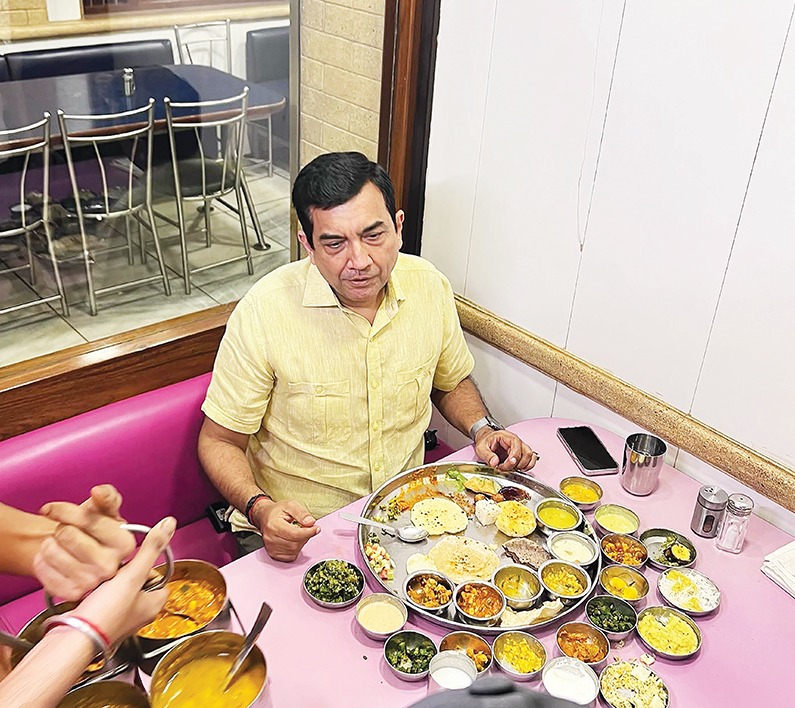
Shree Thaker Bhojanalay is celebrated for its legendary Gujarati thali. Food lovers speak reverentially of its farsans, undhiyu, khichdi, endless breads, fragrant chutneys and glorious Alphonso aamras. But anyone who believes that the restaurant’s reputation rests solely on its food has misunderstood what has made it one of India’s greatest hospitality institutions. Its greatest recipe has never been written down. It lives in two generations of one family.
Every institution has a founding myth. Shree Thaker Bhojanalay has something far more powerful. It has memory. The story begins in Rajasthan, where Maganbhai Purohit was born into a family of ten children. Poverty was not merely circumstance; it was the landscape of his childhood. At the age of ten, carrying little beyond hope, he boarded a train to Bombay in search of work.
The city was never sentimental. It asked for labour before it offered opportunity. Young Maganbhai broke coal for bhattis until soot settled into his skin. He scrubbed greasy utensils, wiped wooden tables and worked in humble lodges serving traders who had travelled far from Gujarat and Rajasthan to make a living in Bombay’s bustling markets. Every day demanded endurance. Every night offered another lesson. Hunger, he would discover, can be an extraordinary teacher.
Without formal education, Maganbhai realised that cooking was one profession that valued discipline over certificates. Professional cooks guarded their recipes jealously and refused to teach an eager young apprentice who might one day surpass them. So he found better teachers.
He entered the kitchens of prosperous Gujarati households as a domestic cook. There, the women of the family became his culinary professors. One home taught him vegetables that celebrated the seasons. Another introduced him to farsan. Elsewhere he learnt sweets, dals, pickles, rotlis and the subtle grammar of balancing sweet, sour and spice. He changed employers not for higher wages but for deeper knowledge, collecting recipes the way others collected fortunes.
It is one of Indian hospitality’s least celebrated truths: some of our greatest chefs were trained not in professional kitchens but by women whose names never appeared on restaurant doors. Maganbhai never forgot his teachers. Nor did he forget hunger.
When he returned to work as a cook in the lodges, he understood something beyond technique. The traders arriving from Gujarat and Rajasthan missed more than home. They missed being cared for. Food was merely the language through which that longing could be answered.
So he opened Shariat Lodge in Zaveri Bazaar, where the meals nourished memory as much as appetite. When that building disappeared, the dream simply moved. In 1945, he established Shree Thaker Club in Kalbadevi. The name reflected another era. Customers purchased monthly coupon booklets and became members of the “club”, not because exclusivity mattered, but because familiarity did. A thali cost four annas – 25 paise – and included two vegetables, dal, rice and rotlis. Chaas and papad were modest luxuries. Sundays were festive, with farsan and sweets for a little extra.
Success did not arrive dramatically. It accumulated quietly. As prosperity grew, Maganbhai bought one apartment after another above the restaurant, expanding floor by floor. When families began associating the word “club” with card tables rather than dining tables, the name changed to Shree Thaker Bhojanalay. The philosophy never changed. Feed people generously. Treat strangers as guests. Treat returning guests as family.
Today’s thali unfolds like an edible map of Gujarat.This is not simply “Gujarati food.” It is Gujarat in conversation with itself. There is the refinement of Surat, the comforting sweetness associated with Ahmedabad, the robust influences of Kathiawad, and the culinary echoes of Rajasthan and Maharashtra that naturally flowed across borders long before states were drawn on maps. Seasonality remains sacred.
The meal reminds diners that Gujarati cuisine has never been one-dimensional. It is a sophisticated conversation between sweetness, acidity, spice and restraint. And then there is abundance. Not the vulgar abundance of excess, but the reassuring abundance of care. One katori becomes another. Another rotli appears before the previous one is finished. No one asks whether generosity is profitable. They simply practise it.
If Maganbhai built the philosophy, his son Gautam Purohit has perfected its expression. Many restaurateurs know every operational metric. Few know their guests. Gautam does. Not because software reminds him. Because he remembers.
He remembers names without making a performance of memory. He remembers favourite vegetables, preferred breads, dietary quirks, allergies, the speed at which someone eats, whether they enjoy the sweeter dal or the tangier one, whether they secretly hope for another helping of undhiyu before finding the courage to ask.
Recognition arrives before the request. That instinct cannot be taught in a weekend training programme. It is cultivated over decades of paying attention. There is another quality that distinguishes Gautam. He gives guests something increasingly rare. Face. Acknowledgement. The feeling that, for the duration of a meal, they are not merely occupying a table but participating in a relationship. He is never intrusive. He never performs hospitality. He embodies it.
There is a lesson here for every hotelier, restaurateur and hospitality student. Luxury cannot manufacture belonging. It can certainly purchase beauty. It can acquire remarkable ingredients. It can commission spectacular architecture. It can train impeccable etiquette. It can automate recognition.
But none of these guarantee that a guest leaves feeling genuinely seen. That requires something far less expensive and infinitely more demanding. Attention. Humility. Consistency. Kindness.
These qualities cannot be installed during renovation.They must become institutional culture. Maganbhai understood this instinctively because he remembered what it felt like to arrive in a city with nothing. Gautam understands it because he remembers people before they remind him of themselves. Together, they remind us that the finest restaurants are rarely built by ambition alone. They are built by gratitude.
In an industry captivated by Michelin stars, celebrity chefs, immersive experiences and ever-changing trends, Shree Thaker Bhojanalay offers a quieter definition of excellence. It asks a deceptively simple question. When your guests leave, what will they remember? The plating? The lighting? The imported cutlery? Or the feeling that, in a city of millions, someone genuinely cared whether they had eaten well?
For nearly eight decades, the Purohit family has answered that question every afternoon and every evening in Kalbadevi. Maganbhai fed a growing Bombay. Gautam continues to welcome a changing Mumbai. Two generations. One philosophy. Feed people generously.Welcome them warmly. Remember them always.
The hospitality industry could spend another generation searching for the secret to unforgettable guest experiences. Or it could simply climb the stairs to Shree Thaker Bhojanalay, sit down before a humble steel thali, and discover that the greatest luxury has never been extravagance.It has always been the grace of being remembered.