
How history, nature, culture, heritage, traditions and culinary delights combine to make Coorg a precious gem
BY SHARMILA CHAND | PHOTOGRAPHS: AKSHAY BALAKRISHNA – AJNA PHOTOGRAPHY
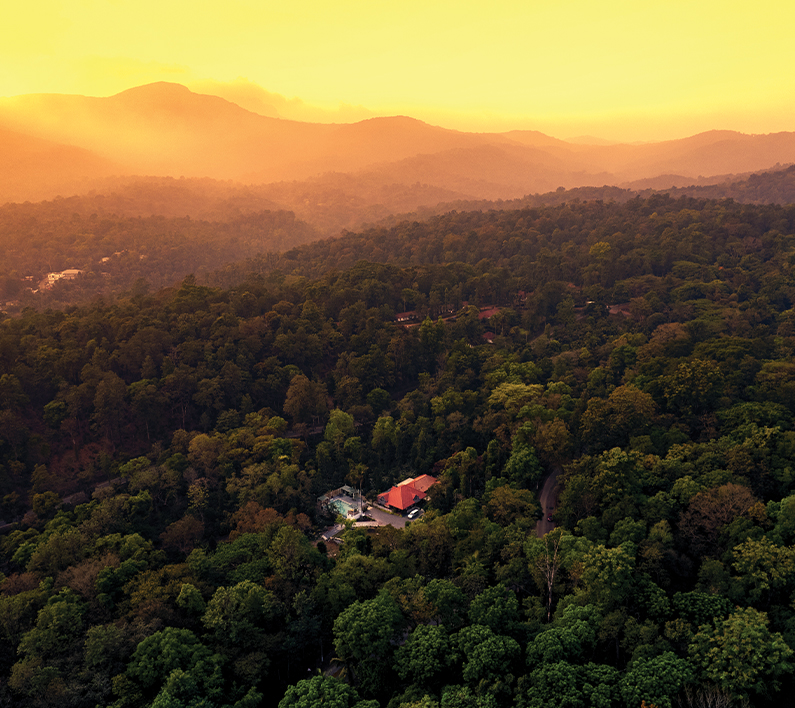
As I love to embrace the local culture and cuisine of the destination I visit, Kodagu, or Coorg as it’s popularly known, was my perfect calling. The first thing that I loved about Coorg was its unique landscape – rolling lush green hills, deep valleys, and dense forest-covered slopes that orchestrate the horizon as far as the eye can see in every direction. Unlike other hills, here one doesn’t see sharp or rocky mountains; instead, they are a beauty carpeted with greenery, coffee plantations, and spice gardens.
An early morning walk through the coffee plantation is the best way to begin your day. I too wanted to do that but something more special was in store for me. Much before my alarm would ring for the walk time, I heard a click-click sound right outside my villa at Evolve Back Coorg Resort.
Yes, it was the sight I was dreaming of.
Malabar giant squirrel (ratufa indica), two of them were on top of the jackfruit tree, extremely busy at savouring their early morning meal. These three-feet-long squirrels are native to this region and look absolutely stunning in their vibrant fur in hues of maroon, orange, and purple. Lucky for me, the resort is their habitat where they can be found gnawing on jackfruit trees, or chasing each other up and down the trees.
I was walking on the ninth cloud after that rendezvous, soaking in the fragrance of aromatic cardamom, cinnamon and vanilla pods. Ripe red coffee berries and pepper vines forming intricate designs on tree trunks, complete the picture perfectly.
THE CULINARY MELANGE
Coorg holds pride of place in having a unique and distinctive cuisine. Influenced by the topography, history and culture, food is an integral part of the native Kodavas for whom ‘Kadi’ i.e. good food and ‘Kudi’ i.e. liquor, makes for a balanced indulgent meal. That’s not all. There is music too with ‘Kadi Kudi’. ‘Aat’ i.e. dance and ‘Paat’ i.e. song, completes their dynamic identity and traditions.
I looked forward to savouring the local cuisine which started with a staple Akki Otti i.e. chapatti made with rice, and Koot Curry mixed vegetables in a coconut paste and vegetable stir fry called Palya. Originally, paddy cultivation has been prominent in agricultural farming, hence, rice is significant in Coorg cuisine. I got to taste Sannakki, the fragrant local rice which they love. Kadambattu, another popular dish of Kodavus, are steamed rice balls, prepared from ground rice, cardamom and coconut and are best served with pickle and pandi curry.
Then there is Baimbalé Curry, prepared with soft bamboo shoots, curry leaves, red chillies and coconut. It is diligently prepared by soaking the bamboo in water for 72 hours before actually beginning to cook it.
I also got to taste a street food favourite – Kuleputtu – prepared from ripe jackfruits mixed with rice, jaggery, salt and cardamom, served in banana leaves.
MUSIC, CULTURE & COFFEE TRADITIONS
Meet local artists and musicians, you will discover how well they have preserved their performing arts. The region’s martial history, harvest festivals, and worship of nature inspire music and dance culture. Kodavas are known for their traditional dances, the circular Ummatt-aat for women and the sword-wielding Bolak-aat for men, accompanied by unique instruments like the dudi (drum) and valaga (horn).
Women look graceful in their traditional sarees dancing Ummatt-aat in a circular formation, swinging in rhythm and clapping while holding brass cymbals. Interesting to see how they pay respect to the river Kaveri through a woman holding a water-filled pot placed in the centre.
Bolak-aat is energy packed dance by men in traditional black attire, holding a chavri (yak fur) in one hand and an odi kathi (Kodava sword) in the other. It is typically performed at night in open fields around a traditional oil lamp. The key instruments they play are the dudi – an hourglass-shaped drum – and the Valaga – a wind instrument similar to a clarinet that provides the foundational beats for celebrations.
‘Coffeeology’ is another significant activity to showcase coffee cultivation process. I attended the session and thoroughly enjoyed an introduction to different varieties of coffee grown in the region and to top it all, tasting too!
You will get to discover Coorg’s coffee legacy and the history of coffee cultivation, from seed to cup, and its deep connection to Coorg’s cultural identity. It’s not just about coffee – it’s about stories, traditions, and a way of life that has evolved gracefully through the passage of time.
OUTSTANDING VANTAGE POINTS
Abbey Falls: Waterfall amidst green vistas is the gorgeous sight here. Surrounded by coffee plantations and dense greenery, the waterfall cascades down rocky terrain, creating a dramatic spectacle. Just listen to the sound of rushing water echoing through the forest, and be in the moment.
Omkareshwara Temple: Dedicated to Lord Shiva, it is an architectural delight, set in the Indo-Saracenic style complete with turrets in four corners and a central home.
Madikeri Fort: You can’t miss the historic Madikeri Fort, located at a short distance from the Omkareshwara Temple. An imposing edifice, it was built as a mud structure in 1681 by Mudduraja and later restructured in granite by Tipu Sultan. The fort houses a church, a museum, and a temple within its compound. Have a look at the collection of weapons used during the reign of Tipu Sultan and the tortoise sculpture marked with the initials of King Vijayarajendra carved on it.
Namdroling Monastery: Get a flavour of Buddhist tradition at Namdroling Monastery. Also known as the Tibetan Golden Temple, it is the largest learning center for the Nyingma Buddhist tradition. Notable for exquisite Tibetan architecture and art, spend some peaceful moments here, turning the prayer wheels, witnessing the resident lamas engrossed in prayer rituals. You will also see three golden statues of about 40 feet each and colourful paintings depicting scenes from Tibetan Buddhist mythology.
Raja’s Seat: Tucked on a gentle hill in Madikeri, Raja’s Seat offers one of the most beautiful panoramic views in Coorg. Unhindered layers of green valley stretch endlessly, with mist decorating the hills, weaving a pretty landscape. No wonder, it’s the favourite sunset point for all photo shoots here capturing the various hues of the sun from orange, pink and gold.
This blend of history, culture, and natural beauty gives Coorg a distinguished identity.
Finally, if you still have the energy, for shopping, of course pick up souvenirs – Coorg local stuff like honey, coffee, spices, and homemade chocolates at local stores in Madikeri town.
For those yearning for a taste of tranquillity and relaxation, Coorg extends a warm welcome in its rolling hills and forests. Vast stretches of green slopes, drifting clouds, misty hills, aromatic plantations, occasional chirping of Great Hornbill and Malabar Whistling-Thrush – there is a symphony of sights and sounds which let me find my own peaceful rhythm here.
And that, I feel, is the reward of visiting Coorg – leaving me calm in a poetic mood, embraced by beauty that is earthy, untouched and pure.