
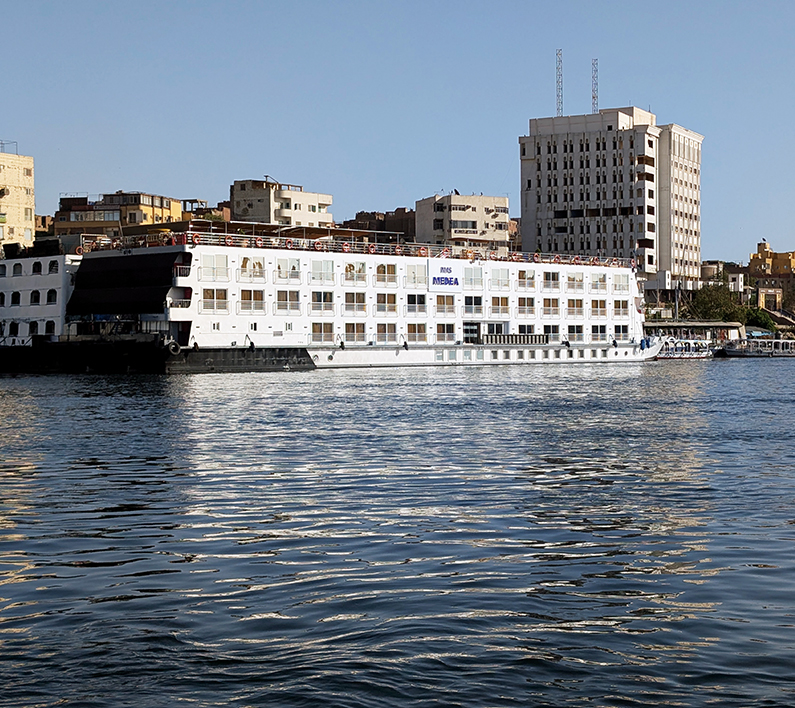
A cruise on the Nile is ideal to experience the beauty of this iconic river while relaxing to its gentle rhythm
BY BRINDA GILL | PHOTOGRAPHS: SATYAJIT S. GILL
Egypt. The Gift of the Nile. The Land of the Pharaohs. An Antique Land. A Cradle of Civilisation. The epithets allude to a country with an extraordinary history – going back 5,000 years – that flourished on the banks of the River Nile.
For five millennia, boats have plied the legendary river facilitating transport, trade, ceremonies and quarried stone for building monumental structures. It has provided water and silt crucial for agriculture. Papyrus growing along its banks was made into paper and offered a precious medium for writing in ancient Egypt.
Tombs and temples, their surfaces embellished with hieroglyphic and narrative scenes of rituals, beliefs and daily life, were built near and slightly away from the river’s banks, and on islands ensconced by its calm waters.
If for millennia, the Nile’s charm, presence and munificence blessed the land, today it does that and draws the 21st century traveller wanting to experience ancient Egypt and its treasures. The river beckons travellers to set sail on its serene waters for a very special tryst with the land, its treasures and people.
The most popular river segment for a Nile cruise in Egypt is between two incredible UNESCO World Heritage Sites: Luxor and Aswan that brings one in touch with the archaeological wonders and antiquities of Upper Egypt. Cruises operate between the cities in both directions, and the distance is about 200 kilometres. As the Nile flows from south to north, southern Egypt is known as Upper Egypt and northern Egypt, marked by the verdant fan-shaped Nile delta, is called Lower Egypt.
Eager to soak in the beauty of the Nile and the history of Upper Egypt, we flew from Cairo to Luxor (ancient Thebes) as part of the Best of Egypt Trafalgar tour for a four-nights cruise. On disembarking, the group headed for the Karnak Temple (1970 BC-30BC) fronted by Avenue of Sphinxes (an impressive 2.7 kilometres path flanked by sphinxes that connects Karnak Temple with Luxor Temple) absorbing the fascinating narration by the knowledgeable tour director.
A vast complex – with monumental gates (called pylons), columns that form the Great Hypostyle Hall, temples, a sacred lake, courts and two obelisks, built over 2,000 years – Karnak Temple gave us a fabulous introduction to the wonders of ancient Egypt as did the Luxor Museum visited subsequently.
The group then headed to the river side – passing through the lobbies of one boat after the other till we reached M/S Medea (a four-level boat with a sundeck) docked at the end! Stepping into its brightly lit and modern lobby with a view of the shimmering waters of the Nile, we were warmly welcomed, offered a delicious chilled hibiscus drink and given our cabin keys.
We took the spiralling staircase to the third level, its stairwell lit by a long sparkling pendant chandelier, and settled into the room – it was neat, well-equipped, air-conditioned and had large sliding windows that offered panoramic views and brought in natural light.
Post an elaborate buffet lunch of a choice of salads, soups, main course dishes, breads and desserts, and a little rest, it was time to visit the Luxor Temple (dated 1,400 BC) located by the East Bank of the Nile, another historic complex fabled for being the site of the coronation rituals of many pharaohs and one that evolved over the centuries as evident by the presence of structures, marks and art dated to different time periods.
As the sun set on the Nile, lights came on creating a magical ambience in the complex. We enjoyed the atmosphere and returned to the boat for dinner.
Next morning, post a hearty breakfast, we headed for the Valley of the Kings taking in views of the landscape, serene river and a bevy of hot-air balloons that floated above. At the site, a shuttle-buggy transported us smoothly, through the rugged landscape, to mesmerising rock-cut tombs, graced with fine paintings and relief work depicting ancient Egyptian beliefs and rituals. Of the 65 tombs, we visited four including the most famous tomb of Pharaoh Tutankhamun (discovered intact with funerary objects in 1922 by Howard Carter) that also has his well-preserved mummy.
Marvelling at the site, its treasures and beauty, we headed for the spectacular mortuary temple of Queen Hatshepsut (1479 to 1458 BC) graced by three vast terraces and imposing colonnades that was accessed by a walk through a bustling bazaar that allowed a quick spot of fun shopping. The next stop was the Colossi of Memnon – marked by two stately stone statues of Pharaoh Amenhotep III (built about 1350 BC as guardians to pharaonic temples), who ‘sing’ when the wind blows through cracks in the stone.
We then walked through a village close-by for an interesting interaction with the village head who offered us freshly baked Egyptian bread and tea, before returning for lunch to the boat.
The boat soon set sail southwards towards Aswan, and we were lulled by its gentle pace, the calm waves, soft breeze and views of fields, palms and vegetation by the banks that were never far.
At times, brown hills appeared beyond the greenery reminding one of the bounty of the Nile in bringing water and silt to its banks that facilitated agriculture. As we were drifting into slumber a voice from the waters called out! Peering out we spotted two men in flowing galabiyas in a small boat (ingeniously tied to ours) displaying textiles for sale and ready to toss rolled fabrics through the window for us to see! With some back and forth between them and passengers in another cabin a deal was struck and money sent down in a bag.
As evening set in, some of us went to the sundeck. With a choice of seating – loungers set by a small pool and table chairs under a covered space, it was ideal spot to enjoy the breeze with coffee and snacks laid out at the counter. The sun gently set across the land, and the sky slowly took on golden hues and the waters shimmered silver and gold.
After the enjoying the serenity, we headed down for dinner –exchanging thoughts with others in our group – over an indulgent spread. There was talk about Esna barrage (built 1906-1908 AD), a lock and dam structure/system (that regulates the river flow and facilitates navigation) approaching shortly.
Back in the cabin, we sat by the windows watching the dark waters outside and enjoying the gentle pace of the boat. After sometime the river broadened and the boat seemed to move to the right side. It slowed down and slipped into a channel with a high wall just outside the window. A gate behind us and another in front closed. The waters slowly rose in the chamber as did the boat. After some time the gate in front opened and we sailed back on the river.
The next day passed restfully as the boat was scheduled to dock only in the afternoon. Breakfast and lunch were enjoyed most leisurely. Some passengers relaxed in their rooms, others on the deck or spa, or enjoyed a spot of shopping at the two stores judiciously located in the foyer before the dining hall.
One store had a variety of crafts, arts and garments including traditional Egyptian attire. The other had jewellery; given the array of art we saw on the surfaces of the monuments it was easy to opt for a cartouche pendant that would be customised with pictorial symbols of ancient Egyptian hieroglyphs of one’s name!
The boat docked late afternoon and we stepped off and walked a short distance to the Temple of Kom Ombo (180–47 BC), built at a slight height. It was an unusual complex of two symmetrical temples, one dedicated to Horus the Elder, and the other to Sobek, the crocodile god. At the base of the complex was the Crocodile Museum with mummified crocodiles that conveyed the respect the animal commanded in ancient Egypt.
Back to the boat we enjoyed an Egyptian evening dressed in traditional attire, with traditional Egyptian food – koshari (a mix of rice, lentils, fried onions, chickpeas and macaroni topped with tomato sauce), mahshi (stuffed cabbage leaves), hawawshi (bread stuffed with minced meat and grilled) and desserts including the most delicious kunafa, followed by music and dance. After the party, we spent some time at the deck, relaxing to the expanse of the night sky and the soft murmur of the waves.
The next day we docked at Aswan, its scenic waters dotted with feluccas (traditional wooden sailboats) eager to experience Nubian culture – as manifest in its architecture, local crafts, spices, perfumes, textiles, and warm hospitality. The group set off in a bus to the shore of the reservoir of the Aswan Low Dam (built 1902) and then took a lovely boat ride to the beautiful Temple of Philae, a UNESCO World Heritage Site, dedicated to Goddess Isis (built in the third century BC, it is located on an island between Aswan Low Dam and Aswan High Dam).
We returned to the shore and drove to the Aswan High Dam (built between 1960-70 to manage the annual flooding of the Nile, generate electricity); the Unfinished Obelisk (dated to the 15th century BC, lying horizontal in the bedrock that gives an idea of how these amazing pillars were created); and browsed through the bazaar nearby for books (the book shop has publications of the American University in Cairo Press), spices and hand-woven textiles. Next was a visit to Elite Aromatherapy where a glass-blower created fabulous glass bottles before our eyes and a perfumist gave an interesting introduction to traditional oils and perfumes, and New Sacrb Bazar, a papyrus store, from where we came away with artworks and bookmarks with our names written in hieroglyphics.
Back to the boat for lunch and a little relaxation, and it was soon time to hop into a small boat to sail a short distance to Elephantine Island where we learnt of its strategic importance for trade in times past, explored its monuments (including a fascinating nilometer that measured the water level of the Nile), visited the Aswan Museum and took in views of the mainland with its landmarks of Archangel Michael’s Coptic Orthodox Cathedral and the legendary Old Cataract Hotel. Back in the boat, we sailed around the island with the guide point outing out colourful Nubian homes, birds, vegetation, the mausoleum of the Aga Khan, Monastery of St. Simeon Monastery, Tombs of the Nobles and Dome of Abu Al-Hawa on the West Bank.
We continued sailing past Kitchener’s Island home to Aswan Botanical Garden before heading back to the boat. Dinner was another elaborate spread and fun affair with conversations and goodbyes as we were to disembark the next morning with memories of a lifetime.